 WOVEN PLATEAU
The Color of Patience
Before a single knot is tied on a Tibetan carpet, another art has already been practiced for weeks or months: the art of natural dyeing. It is slow, unpredictable, and irreplaceable.
June 2026 · 4 min read
The Dyer's Alchemy
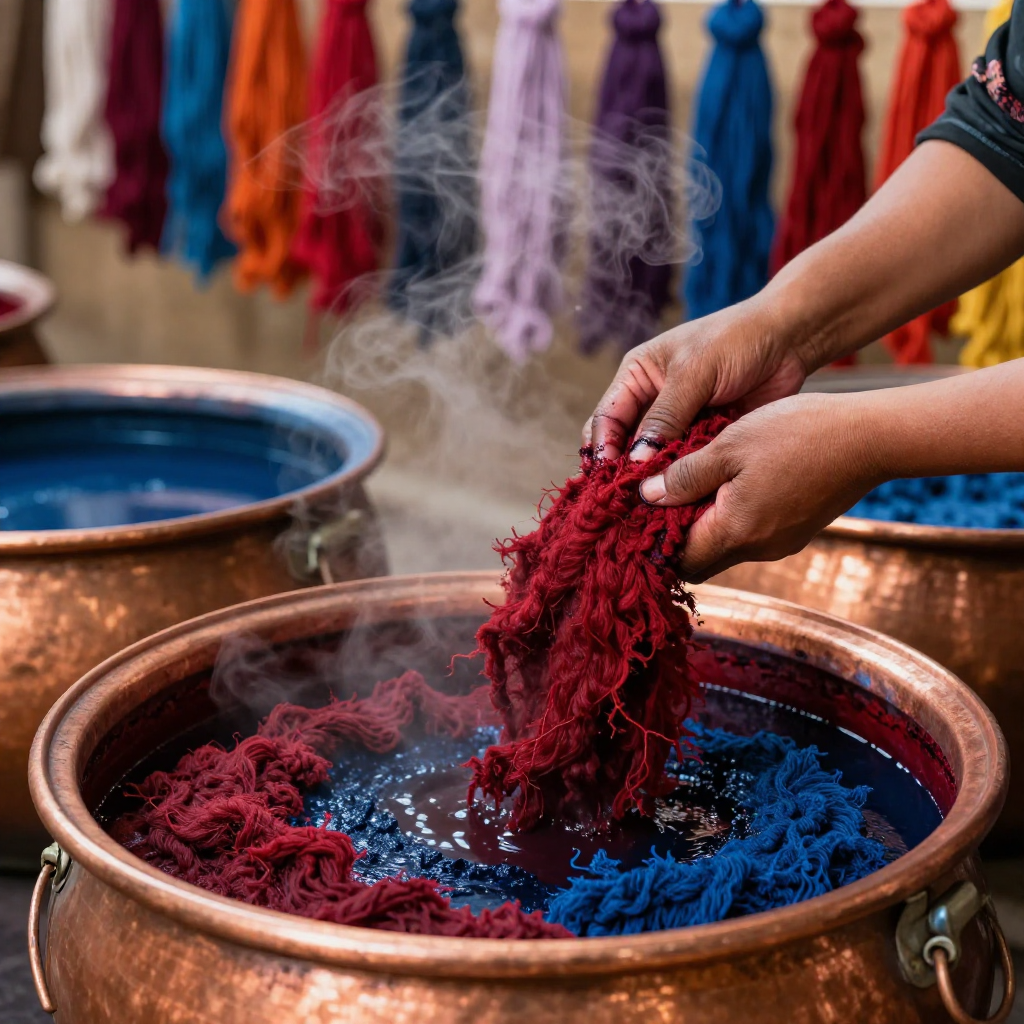
Natural dyeing is not a formula to be followed but a process to be understood. Each dye source — plant, root, bark, mineral, or insect — demands its own treatment. Madder root yields a spectrum from soft coral to deep crimson depending on the water temperature, the mineral content of the water, the mordant used, and the duration of the dye bath. Indigo must be fermented in a living vat that requires daily attention, like a sourdough starter or a garden.
The dyer's knowledge is a form of embodied chemistry — learned through years of observation and practice rather than from textbooks. A skilled dyer can read the color of the dye bath, adjust the temperature by feel, and know when the wool has absorbed enough color by the way it moves in the liquid.
The Tibetan Palette
The traditional Tibetan palette is rooted in the landscape:
- Red & Coral — Madder root (Rubia tinctorum), yielding the signature warm reds of Tibetan carpets. The intensity depends on the number of dye cycles and the mordant concentration.
- Blue — Indigo (Indigofera), fermented in vats over weeks or months. Indigo dyeing is particularly challenging because the dye is insoluble until reduced by fermentation — requiring a living, breathing dye vat.
- Brown & Tan — Walnut hulls, producing warm browns from light tan to deep espresso. Walnut is one of the most accessible and reliable natural dyes on the plateau.
- Yellow & Gold — Local plants including rhubarb root, onion skins, and various plateau flowers. Yellows are often used as highlights or in combination with indigo to create greens.
- Orange — A combination of madder red and plant-based yellows, or from specific local dye sources like Tibetan lycium.
Why Natural Matters
The difference between natural and synthetic dyes is not just philosophical — it is visible and tactile. Natural dyes penetrate the wool fiber, bonding at a molecular level and becoming part of the material rather than coating its surface. This means natural colors age gracefully: they mellow rather than fade, developing a patina over decades of use.
Synthetic dyes, by contrast, sit on the surface of the fiber. They can be brighter initially but fade unevenly, and they lack the depth and complexity that comes from natural variation.
Perhaps most importantly, natural dyes carry a quality of aliveness. No two dye batches are exactly the same. The madder harvested in one season may yield a slightly warmer crimson than the next. The indigo vat responds to temperature and humidity. This variability is not a flaw — it is the signature of a living material, and it gives each carpet a color character that is genuinely one of a kind.